
Apologies for the radio silence. Ever since I last wrote I’ve been poorly with this whatever it is the OH and I have had. He has had a vaccination for some respiratory virus going around and finishing old people off, I’ll have mine next week but I think it’s a bit pointless, I think this is what we’ve had. So, uncharacteristically, instead of writing that I was ill I have just been ill.
However I am now better and finally got digging.
I love a bit of digging. Not necessarily archaeology, not through somebody’s bin for incriminating paperwork, not through the kitchen cupboard for the OH to find the garlic powder (he has turned himself into a cook, which is just as well, I wouldn’t use garlic powder if it came free with gold bars) not through the sock drawer to find the pair without the hole, but actual digging in the soil.
You really cannot beat a bit of digging for sorting out your mental problems. Digging is so simple. You shove your fork in, you lift it out, you jiggle it a bit, you take off the weeds and stick them in your bucket and you smash the soil with your fork until it is smoothly in little bits.
This of course will not work everywhere. When we lived in Aylesbury I barely got going on the digging before we moved, which was just as well, the soil was, mostly, solid clay, which is very similar to concrete. You can grow roses in clay, in fact they like it. They like to feel their roots are very secure. Some plants do like restricted roots. Agapanthus, for example, are not happy with endless loam, they much prefer a small pot. I had one that was so happy in a small glazed pot it grew in a very unfettered but fettered way until the roots broke the pot.
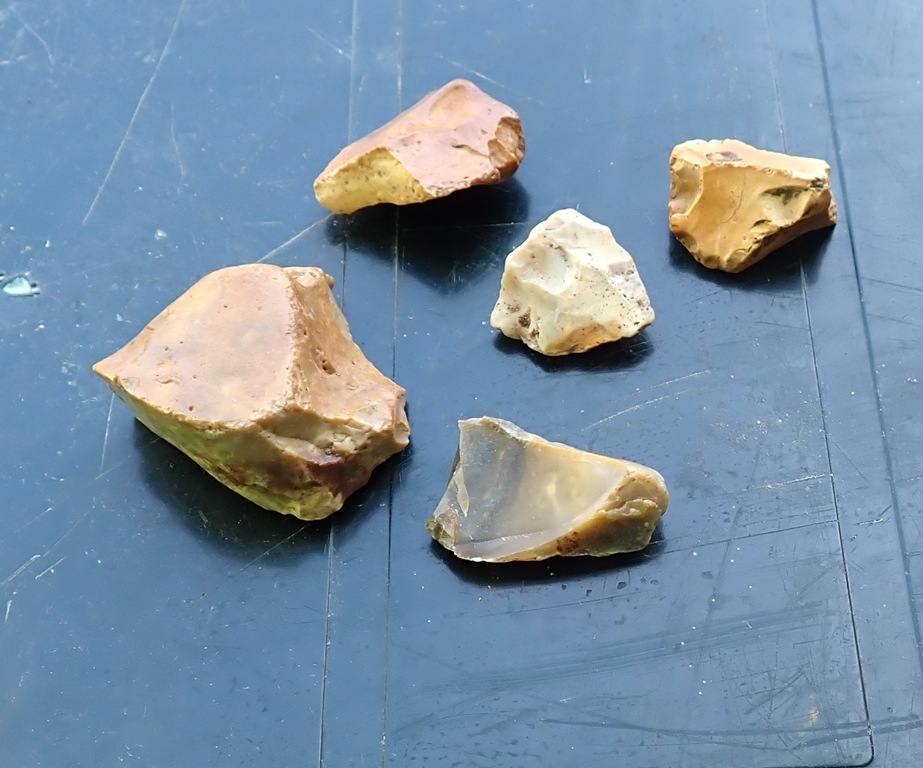
If you are digging, or contemplating digging, it helps to know what your soil is before you begin. It helps to know who was digging there before you. Two thousand years before I was digging here, the area from the river to the top of the hill was a neolithic flint factory. When digging I come across the ends of stones from which all the sharp edged tools that can be struck, have been stricken. I have quite a collection.
I also come across glass. The biggest bit was a piece of Victorian window. In this time frame, the land my house stands on was where the gardener’s hut stood. The gardeners in question were working on the market garden for the posh estate, growing food to feed the nobs. Opposite me, going up the hill, there’s a pair of old semis that were the gardener’s lodgings. They are quite extensive and were the houses of many workers, the posh house they served is now a ruin, although it was a vast Palladian Mansion and stood down by the River Avon, well away from the workers located out of sight, up the hill.
The area in Warwickshire in which I live has had this division between rich and poor noticeably marked for centuries. The posh houses tend to become increasingly expensive for normal people to inhabit. On the way into town Priory Park used to be the site of the twelfth century Priory, then the Tudor Mansion built in 1556, which is no longer there because it was very carefully demolished, the bricks numbered and the entire house shipped out to Richmond Virginia and rebuilt. All that is left is some foundations in the soil.
The answer always lies in the soil. It constantly amazes me that archaeologists can tell where neolithic round houses, built of grass and sticks, stood, by the changes in the colour of the soil where the roof dripped outside of the walls.
I do love soil. It is incredible stuff. Of what it is composed is that which is decomposed. My garden is used as a toilet by the cats from next door, because their garden is two rooms outside; a lounge with waterproof sofas and a dining room on a floor in the corner. I don’t mind. I like the cats and one, in particular, always has a chat to me when we meet. They are enriching my soil, eventually. This is traditional. The previous town but two, in which I lived, up North, had many terraced houses back to back with the privy at the end of the back yard. In the back street each privy had a slide up metal door which gave access to the contents for men with long shovels known locally as the Midnight Mechanics. I am old enough frequently to have seen people rush out into the front street with a shovel after a horse and cart had passed by, to collect the manure for their roses.
In the next town I lived in, in the Seventies, the building of a new shopping centre unearthed the tannery pools. Here the smelly business of tanning leather, that essential mediaeval wardrobe staple, was carried out, for hundreds of years, in a series of pools. The first containing strong human urine, took the hair off the cow hides, the second, with weaker urine, softened the hides and the last, filled with dog faeces and pigeon poo which were massaged into the leather, by hand, before the invention of rubber gloves, made the leather workable to wear at court and similar venues. It’s enough to make you feel that whatever your job is, it’s quite dainty. It also gives a clue as to why sweet smelling pomanders were carried fashionably at court. Henry the Eighth, after he had been dead for a few days, exploded. Right up the arras behind the curtain. Given the usual odours at court it may have been a while before anyone looked, they were probably all sniffing each other and asking: ‘Is that jerkin new? Your shoes? Your britches? Anything?’
The tannery was discovered, needless to say, by changes in the soil, not, as you might imagine, by the lingering pong, though when I visited the new excavations in the Seventies, there was definitely a very, um, earthy smell. It’s worth remembering, next time you would like to bury your nose in one of those leather handbags that cost a thousand pounds and have a waiting list, that the smell may not be of money after all.
What else is in the soil apart from rubbish and assorted poo? Dead bodies, of course. My late father did not have a dead body, he had left his to medical science without telling anyone, but my mother, cremated, was sprinkled on the roses at the crematorium and a very fine rose garden it was. Roses like a bit of bone meal. Sooner or later we will all be soil. It is interesting to speculate, given tectonic plates, that all the soil in one part of the planet is plunging into the middle, only to be turned into lava and emerge elsewhere.
Lava is interesting. Visiting Herculaneum we were very aware of excavations on site by the sound of drilling. When the archaeological soil is solidified lava, you need a really big road drill, rather than a trowel and a sieve. It was Guiseppe Fiorelli at Pompei, who, discovering holes in the lava as he excavated, realised that the holes were where the vanished Romans who did not escape, had died, been covered in pumice and rotted away. He filled the holes with concrete and the Ancient Romans re-emerged, an extreme case of what was not in the soil being defined by its absence.
It is incredible, when you think about it, that all we eat is either grown on the soil of the planet, eating the plants that grow in the soil, or eating other creatures that eat the soil. We are made of soil and, after a brief period, in the life of the planet will become soil again, plunge into the mantle and come back as rock, weathering to soil.
We are the planet and the planet is us. We are the original recycling. The soil I grow my plants in and find the leftover flint tool bits in is made of the tool makers.
~~~~~~~