
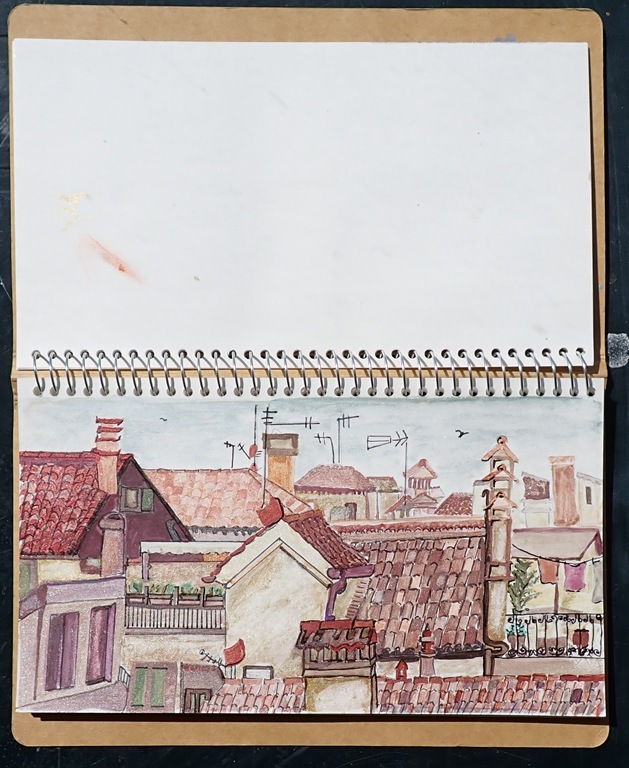
Every foothold that could be occupied was taken up. Not one inch was wasted. Every little bit of flat roof had a terrace patio on it. Every roof which did not have a patio on it had an ariel, a cooling tower, a chimney, another construction to ventilate yet another room squeezed into another tiny corner. To label the result as ‘density of occupation’ understates the case considerably.
I found the view utterly magical and, first into the bathroom every morning, used the time in which the OH was performing his ablutions to sketch the enchanting view from our window. There was a lot to draw, it took all week and I enjoyed every minute of it. The sketch is eight and a quarter by four and a half inches wide. I may show you again because that will not be the finished size in the eight inch square scrapbook. I may lose a bit off the left, to the frame.
The colouring is done with watercolours. I took the Stamperia metallic watercolour paint set, which is just over two and a half inches square and has a removable lid to use as a mixing tray and the Kuretake Kobako watercolour set, which has just five pans and a spare, which I replaced with another pan. The Kuretake watercolours change as you paint, the more water, the greater the change.
Venice is full of opportunities to paint and draw; it has been designated the City of Art for a long time, having been attracting artists in every medium for centuries, by virtue of the enormous wealth of the city state providing patrons who wished to be immortalised in public buildings by the very best artists.
I did not see anyone else drawing, though very few people were not using camera phones, in fact so many visitors had their phones in their hands I wondered what visitors had done in previous centuries.
Venice is a collection of streets, in which, as every map warns you ‘conditions on the ground may not closely resemble reality.’ The shortness of space has caused another little shop to be built in a tiny gap, so that a straight street now has a bend in it. The streets themselves are so narrow that most professional basketball players would be unable to lie flat across the street. There are no powered wheeled vehicles, the only possibility for getting about is on foot or by boat. There are about 150 canals, 400 bridges and 400 gondoliers.
The OH, at first very annoyingly, until I observed newcomers doing the same, speedily developed the habit of running along a street with his phone held high, shouting that he knew where he was going. Sadly, Google Maps did not share his conviction. I learned not to try to keep up with him but to dawdle along and enjoy the shop windows until he came surging past me, going in the opposite direction. Most maddening was encountering him at a cross street, spinning in a circle.
After a few days without my head in a phone, I began to develop a sense of where we were.
The best place to be is sitting under a big sun umbrella, outside a café, with a long cool drink, sketchbook in hand. We had ventured to the south of St Mark’s Square, which is, without a doubt, the place to be (of which more later) and found a place to sit and draw and drink overlooking the Grand Canal. I started drawing when quite suddenly a downpour began. Waiters rushed out to close the umbrellas and take them in and we sought the safety of the dry colonnades, which surround three sides of the square. So it was a couple of days later when I returned to finish the drawing of the interesting skyline on the other side of the canal.
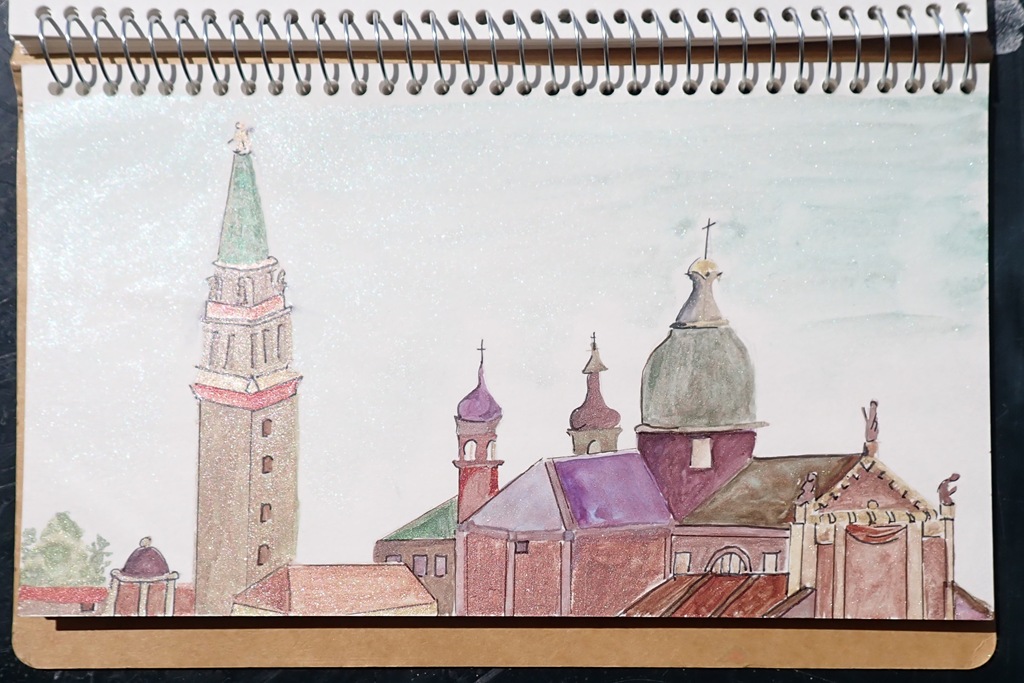
Venice has been trading with everywhere else that can be reached by boat for centuries. Eastern buildings, Moorish domes, Greek pillars, minarets and more, are all there along with the wonderful Italianate bell towers. These influences create the fascinating skyline which confirms that Venice was the trading hub for the known world right through the mediaeval period. It has spawned sailors, statesman and explorers who have left their mark, even up to the modern airport, on the mainland, which is called the Marco Polo airport. By the time you have queued through customs and got on your first vaporetto (a water bus), you can be feeling quite adventurous yourself.
~~~~~~~~
More of my art adventures in Venice to come. Stay tuned!
The sketchbook I used was the Traveler’s Company spiral ring notebook with watercolour paper available from www.cultpens.com
~~~~~~~~