It’s taken a while because I’m not rushing anything. I still have half the pictures in the sketchbook to colour. I will have to stop and do dolls shortly but it’s too hot again to do anything as active, so water colouring either in a shed or with a fan is the ideal occupation.
I’ll show you some of the pictures from the Basilica San Marco, the wonderful church which was built in 829 AD to house the relics of the body of St Mark, stolen from Alexandria. Scroll down if you are not sure why anyone would steal body parts in antiquity, regular readers (hello) know all about this. After a fire in 976 the church was rebuilt in 1063 and continually updated; when we were there conservators were dusting assorted saints with soft brushes.
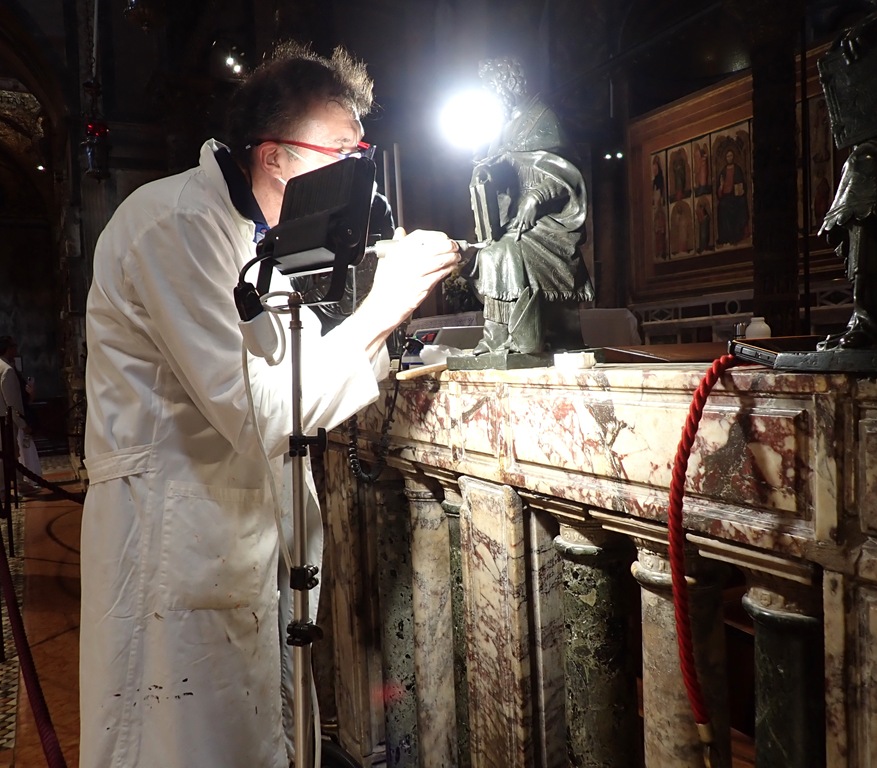
Here are the saints who have already been dusted.
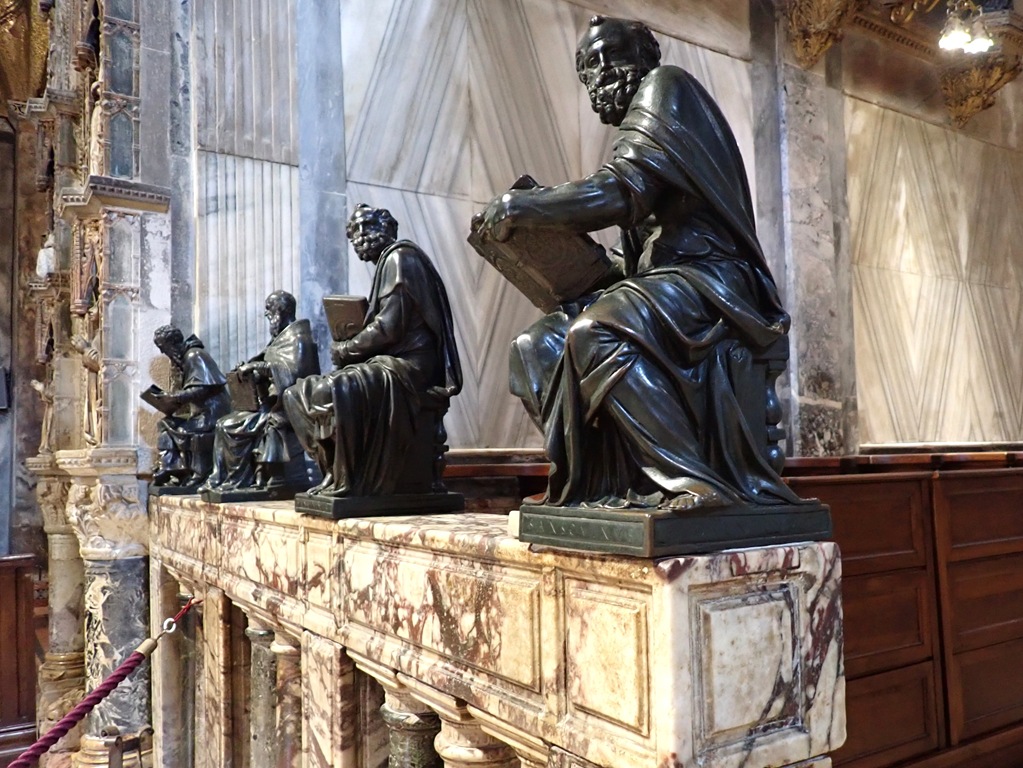
All very keen on you reading the gospels by the look of it.
The Basilica is full of works of art, like many public buildings in Venice. The way in which Venice developed is the reason for this. Ruled for most of a millennium by a council of ten of the most worthy Venetians (for which read richest trading families) who elected the Doge, who had little power on his own, the city state began, quite early in its history, to be a showcase of the best collections of the richest collectors, all trying to outdo each other.
We have parallels in our own time of world famous billionaires who enjoy hiring entire towns for their weddings and are currently engaged in rivalry as to who will get to the Moon, or Mars, first to own large chunks of either.
The Venetian empire builders were quite often at odds with their neighbours, which neighbours, at various junctures, included the Vatican. In such a Catholic country, endowing the biggest church with works of art had the delightful double objective of cocking a snook at the Pope and securing a place in heaven.
The Basilica, the major church right on the town square, next to the Doge’s palace, was never going to be ordinary, or a bit plain.
It is utterly breath taking. I could post something different about it every week for a year. From the tiled floors to the ceiling and everywhere in between there are wonderful works of art. Part of it is a museum, protecting and safely keeping amazing ancient bibles and textiles, in dark, climate controlled cases.
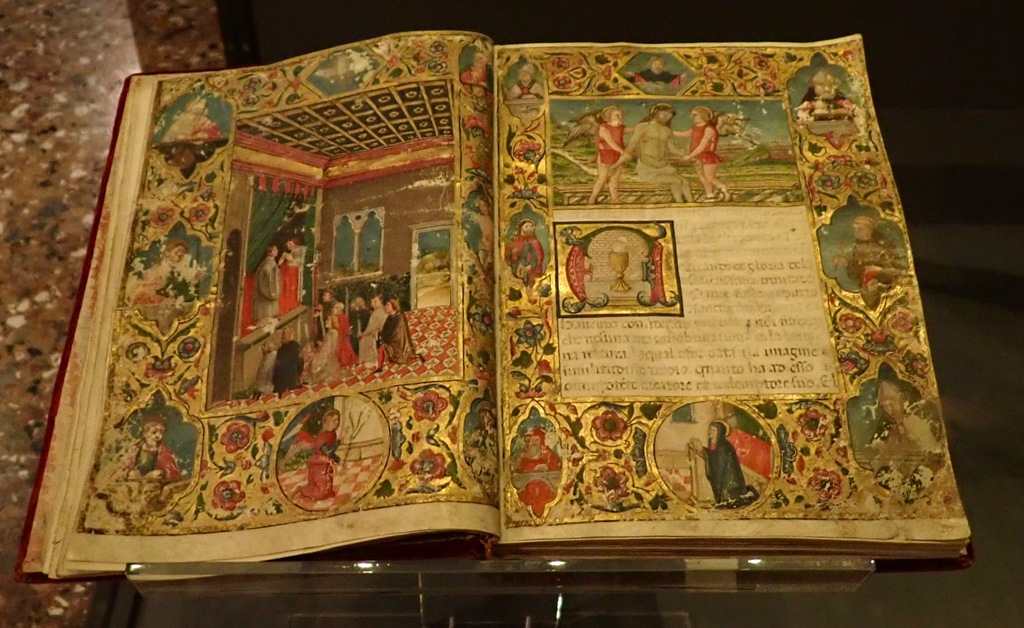
Liturgical artworks are everywhere, not least all over the walls and ceilings. As the roof is composed of five domes in the shape of a Greek cross, there’s a lot of ceiling.
I loved the naïve mediaeval depictions of various bibles scenes but the one that absolutely drew me to it was the most amazing mosaic of Christ Pantocrator in the semi dome of the apse.
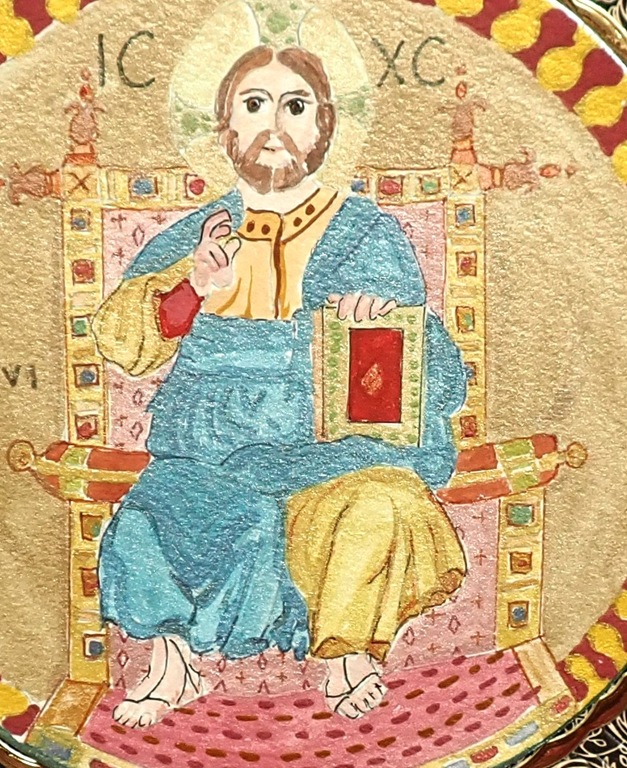
This depiction of Christ as the creator of the Universe was originally designed by Byzantine artists for the mediaeval construction of the Basilica. I love it so much I have drawn my version twice, adding a circular pattern, where the original sits simply on the golden background of the ceiling.
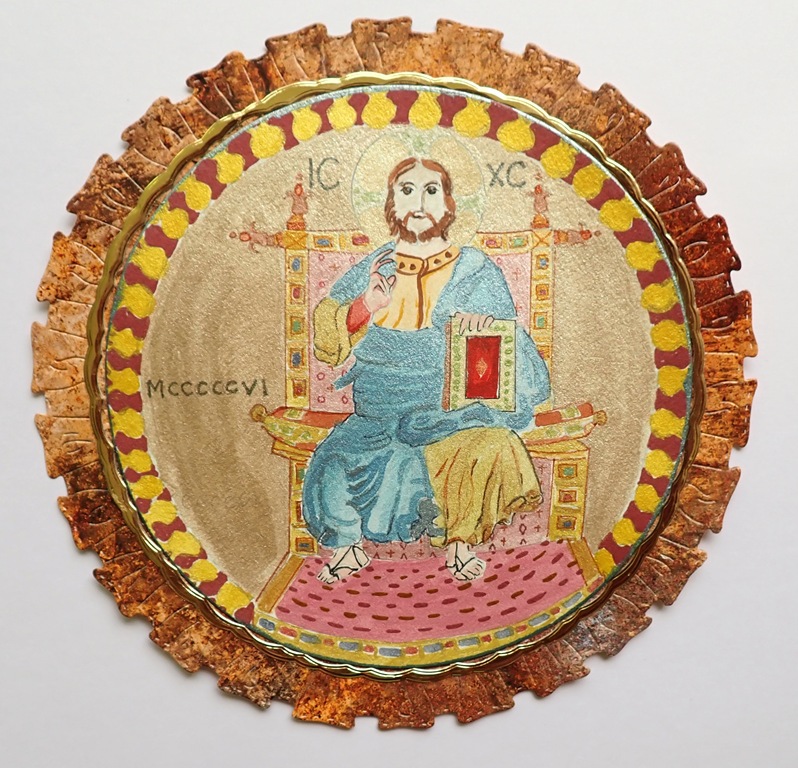
As you can see the picture was redone by Venetian mosaicists in 1506. They had learned the techniques from the Byzantine artists who had (maybe) remarked: Oh this is nothing, you should see our horses!
The restorers also added the Christogram IC and XC. In the early church, Christians who were persecuted for their faith, developed numerous secret signs. The I and C to the left stand for iota and lunate sigma, the first and last letters of Jesus in Greek and the second X and C stand for chi, and again, lunate sigma, the first and last letters of Christ in Greek.
I loved painting this. The first is the version which will go in my Venetian scrapbook. In the mosaic, Christ is raising a hand in blessing and showing you the gospels. The mediaeval artists who first designed this must have realised that a golden throne edged with precious set stones might not have been very comfortable, especially for Someone who is going to be sitting there for all eternity, so they have given Him a long, very mediaeval, stuffed cushion.
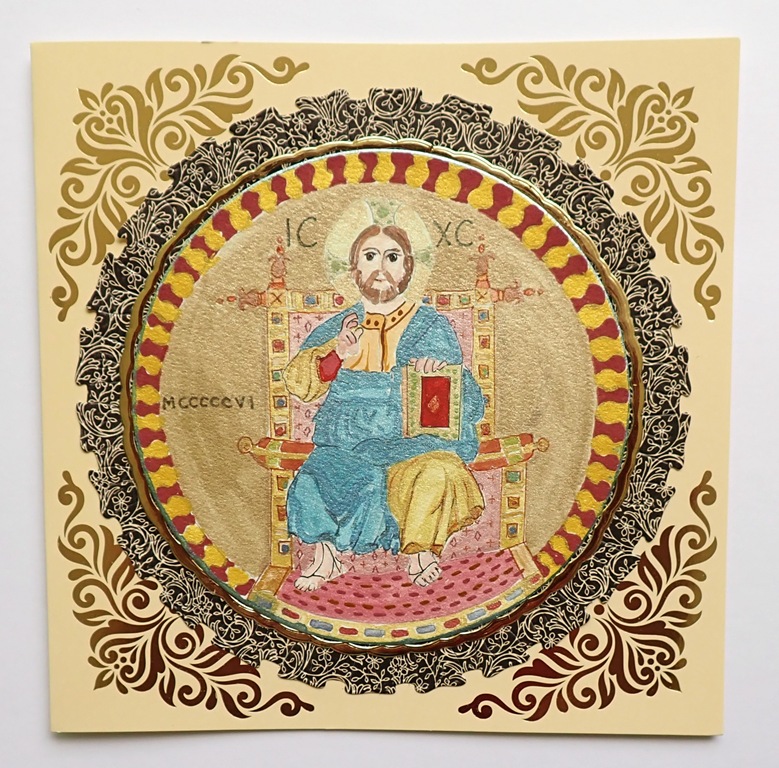
The second version I have made into a card to send to a friend who is currently looking after her demented mother in another country, she expects to be there until Christmas. A little divine inspiration would not go amiss, perhaps.
The Basilica San Marco is one of the glories of Venice. I loved every inch of it.
~~~~~~~~~~~~~~~